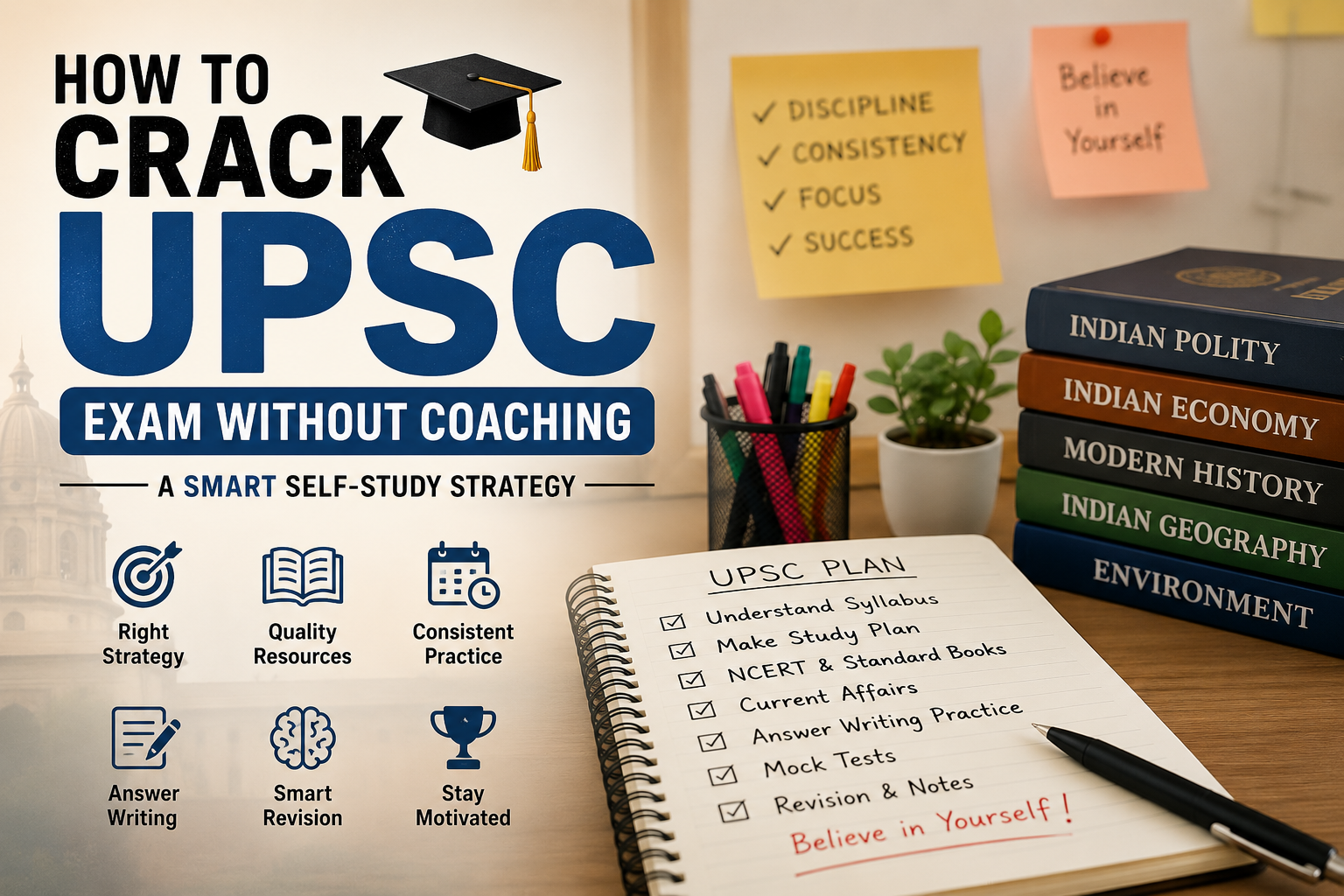
How to Crack UPSC Exam Without Coaching in 2026
Every year, thousands of UPSC aspirants ask the same question: Can I crack the UPSC exam without coaching?
on smart preparation instead of collecting endless study The answer is yes—but only if you follow a structured plan, stay disciplined, and focus materials.
In 2026, self-study has become more practical than ever. High-quality books, government publications, online lectures, current affairs resources, and mock tests are widely available. What matters most is how consistently you use them.
This guide explains a realistic strategy to help you prepare for the UPSC Civil Services Examination without joining a coaching institute.
Why Coaching Is Not Mandatory for UPSC Success
Coaching can provide direction, but it cannot replace self-study.
The UPSC examination tests:
- Conceptual understanding
- Analytical thinking
- Answer-writing ability
- Consistency
- Decision-making under pressure
These skills improve through regular practice rather than classroom attendance.
If you can study independently, evaluate your mistakes, and revise systematically, you can prepare effectively without coaching.
Step 1: Understand the UPSC Syllabus Before Studying
Many aspirants start reading books without understanding the syllabus.
Instead:
- Download and read the complete syllabus.
- Break it into smaller topics.
- Link every subject with previous years’ questions.
- Avoid studying topics that are outside the exam scope.
A clear understanding of the syllabus saves time and improves focus.
Step 2: Analyze Previous Year Question Papers
Before making a study plan, review questions from recent UPSC exams.
This helps you identify:
- Frequently repeated themes
- Important subjects
- Question framing patterns
- Expected depth of knowledge
Many topics appear in different forms across multiple years, making PYQ analysis one of the highest-value preparation activities.
Step 3: Build Strong Fundamentals
Strong basics make advanced topics easier.
Start with:
- History
- Geography
- Polity
- Economy
- Environment
- Science and Technology
- Ethics
Focus on understanding concepts instead of memorizing facts without context.
Step 4: Limit Your Study Resources
One of the biggest mistakes is buying too many books.
Follow a simple rule:
- Choose one reliable source per subject.
- Revise it multiple times.
- Make concise notes for quick revision.
Depth of understanding beats quantity of material.
Step 5: Create a Sustainable Daily Study Routin
Instead of studying for extremely long hours, build consistency.
An example routine:
- 2 hours: Core subject study
- 1 hour: Current affairs
- 1 hour: Revision
- 1 hour: Practice questions or answer writing
- 30 minutes: Note consolidation
The exact schedule can vary, but regularity matters more than intensity.
Step 6: Read Current Affairs with Purpose
Do not try to memorize every news story.
Focus on issues connected to:
- Governance
- Economy
- International relations
- Environment
- Social development
- Government policies
- Science and technology
Make brief notes that can be revised before the exam.
Step 7: Practice Answer Writing from the Beginning
Many aspirants postpone answer writing until the last few months.
Instead:
- Write short answers regularly.
- Use introductions, structured points, and balanced conclusions.
- Support arguments with examples where relevant.
- Stay within the word limit.
This habit develops clarity, speed, and confidence.
Step 8: Attempt Mock Tests and Learn from Mistakes
Mock tests should not only measure performance—they should improve it.
After every test:
- Review incorrect answers.
- Identify conceptual gaps.
- Note recurring mistakes.
- Revise weak areas.
Improvement comes from analysis, not just participation.
Step 9: Revise More Than You Read
New information is useful only if you remember it.
A practical revision cycle:
- Daily review of notes
- Weekly revision of completed topics
- Monthly consolidation
- Final revision before exams
Frequent revision strengthens long-term retention.
Step 10: Maintain Physical and Mental Well-Being
Preparation is a marathon.
Support your performance by:
- Sleeping adequately
- Exercising regularly
- Taking short breaks
- Eating balanced meals
- Avoiding burnout
A healthy routine improves concentration and productivity.
Common Mistakes That Reduce UPSC Success Rates
Avoid these frequent errors:
- Constantly changing books
- Ignoring the official syllabus
- Skipping previous year questions
- Delaying answer writing practice
- Studying without revision
- Following unrealistic timetables
- Comparing your progress with others
Eliminating these mistakes can significantly improve preparation quality.
Best Self-Study Tips for UPSC Aspirants in 2026
- Keep your resources limited and organized.
- Prioritize conceptual clarity over memorization.
- Solve practice questions consistently.
- Revise regularly instead of chasing new material.
- Track your progress every week.
- Stay patient during slow phases of preparation.
- Focus on steady improvement rather than perfection.